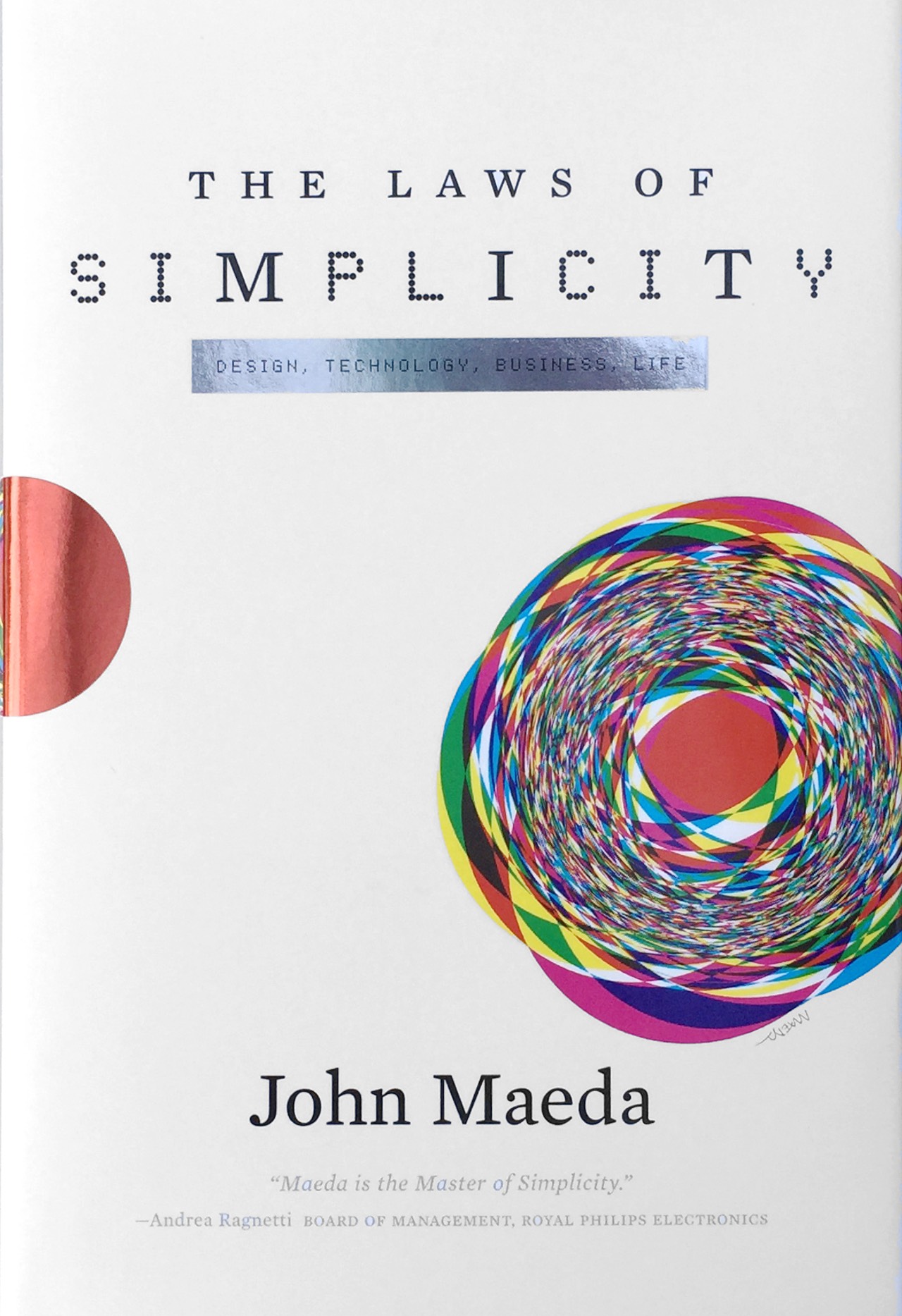
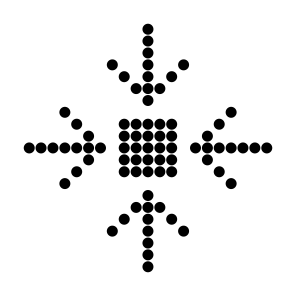
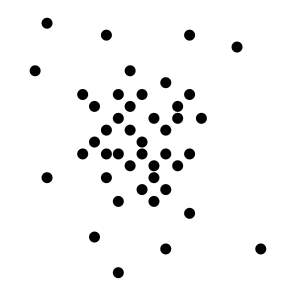




Simplicity is about subtracting the obvious, and adding the meaningful.

17 Responses to “Law 10: The One”
Comments Area
NOTE: I reserve the right to edit or delete inappropriate comments. But I'm also a believer in free speech. Keep it simple.
Love the topic. Appreciate your focus. Occam’s Razor.
Regarding Law 10, are the Obvious and the Meaningful necessarily exclusive of each other? Quite (Most?) often the most obvious thing, such as an obvious solution, can be the one with the most meaning. Is that not what the Razor teaches us?
I suppose Law 10 could theoretically still work if the Obvious and the Meaningful are one and the same. Subtract the Obvious, realize it’s the Meaningful, and then add it back, leaving you where you were in the first place. You’ve done something twice, dabbling in complications.
But hey, that’s cool. See Law 5!
I’m not a student of Occam’s Razor but now I am. PS The tenth Law was meant to be an encapsulation of all nine Laws. This point is made clear in the book but not this website — a Law 5 Difference, but not necessarily a good one. I’ll make that clarification … but I guess it’s already made.
I wonder if the term ’simplicity’ itself can be construed as being overly formalist and vague in defining what users really want from many of their designed artifacts. Yes, we want clarity, elegance and functional transparency, but how does one instill meaningfulness into a product in a more profound way? Have you thought about–for a lack of better terms–the “ethical component” of simplicity as a type of sensibility from which to design? Sustainability, facilitating social and private acts, embuing a culture with signs–these topics are all impacted. I would be very interested in hearing your thoughts.
Isn’t “obvious” a relative (and dynamic) term? What is obvious to one may not be obvious to others and it can evolve as time passes.. What are your thoughts?
I admit that it’s a bit pompous to claim that something can be “obvious” if taken directly. In my mind figuring out what is obvious is actually quite difficult. It seems like everyday I figure out what might be obvious to others. So I use the term “obvious” with only the highest amount of respect.
First, Thank you for your book.
Second, This law is subjective. I have a IPod Shuffle and I think what is meaningful to me was not obviously meaningful to Apple.
I’m 56 and the design was more suited for the under 30 crowd and the instructions were abysmal. I guess young folks don’t read instructions:they just socially network with each other to solve problems.
But not to completely diss the ipod. I like what it was designed to do: listen randomly to podcasts,music and to be unobtrusive.
I wonder when companies will let all consumers help in the design of the meaningul and the obvious.
Hello Sandra, It’s interesting because yesterday I was talking to the accessibility folks at NPR Labs about this very issue of being “designed for the task.” They were talking about in their experiments in designing for the hearing- and visually-impaired, and how certain unobvious facts emerge. For instance, with all these screen-based devices on iPods and such, kitchen equipment manufacturers have followed suit. So whereas objects may have been more button/tactility-focused before, now they require the ability to physically *see* more than ever before. But also that folks in this limited accessibility category absolutely do not want a device that is specifically designed “for the impaired.” To me this said that you can (or should) design to be hip, relevant, and universally acceptable. Thank you for your comments. They brought out the meaningful and the unobvious.
John
With all respect - I really love the book - I am very disappointed in law 10!
I think it’s a rule rather than a law…It maybe applicable sometimes but looking at great designs and artifacts “the subtracting the obvious”-bit simply is incorrect.
Let me rephrase: “Simplicity is about finding the obvious, and adding the meaningful”.
The “obvious” often is the main recipe for simplicity! Haven’t you ever come across products/solutions in your life where you say: “Sh*t, it’s just so easy - read obvious - why didn’t anybody come with this earlier?”
Context often distorts good analysis of a problem. That’s why finding the obvious isn’t all that obvious! The challenge is simplifying the problem - for this use the first 9 laws
- and thy shall find the most purest, simplest and most obvious solution!
Hello Kristof, The 10th Law is indeed a bit of an oddball. It was more of an intuition versus anything grounded in more fact (or even a set of deeper stories). Thanks for invoking the 9th Law .. that’s what it’s there for. In my next career I want to become a lawyer I think, so maybe the 9th Law is my “Disclaimer Law”
Best wishes for 07, John
Simplicity is about making the essentially meaningful obvious. (While effectively abstracting away the rest).
Better than Occam in this context is McGraw’s razor - ‘is that workin’ fer ya?’. (Because even William of O’ implies that occasionally the more complex theory is correct. I fear Occam’s razor has been *cough* oversimplified.)
The ‘Obvious’ is a shared context, the ‘Meaningful’ is a context brought into focus by the design. This would be a formula to produce simplicity. The better question is, what does this simplicity accomplish? Is this simplicity profound, or merely simplistic?
If it’s so obivous that nobody came up with it before then that by definition makes it something NOT obvious.
If something is obvious to you, which is not to others, you are a visionary.
If you can communicate your vision to others, you have yourself a design
Hmmmmm. The “visionary defense.” That’s a new one I think. Nice addition Johan. Regards, John
è essenziale quello di cui non possiamo fare a meno; quindi persone appartenenti a contesti differenti hanno differenti idee su come si può semplificare un sistema qualsiasi, a causa delle differenti priorità dettate dal contesto in cui sono inserite. Se quello che dico fino qui è esatto, da un punto di vista culturale, la semplicità non può essere propria dell’ oggetto, ma dell’uso che noi intendiamo farne.
In fondo dunque, si tratta più propriamente di individuare quale sia il numero minimo di funzioni da soddisfare senza che si avverta il bisogno di dover acquistare un altro strumento per soddisfare lo stesso bisogno in maniera più completa e meno onerosa, ma solo relativamente ad un mercato specifico.
Poi, ogni tanto, sbuca un Munari e ti inventa i pre-libri, e tutte queste chiacchere sui rapporti di equilibrio tra indispensabile e superfluo se ne và alle ortiche, eh eh. Al di là degli equilibri ci sono le novità che li sconvolgono, è quello il vero design!
Whatsoever things are true, whatsoever things are honest, whatsoever things are just, whatsoever things are pure, whatsoever things are lovely, whatsoever things are of good report…
As a human being seeking simplicity, this passage exemplifies one of the truest examples. I look forward to reading your book. Deb
Today been made aware of “The laws of simplicity” and having spent the last several hours poring over the comments, journeying the links and visiting amazon to buy the book. I must thank you and your “posters” for the great “find”.
I am a bit embarrased about not having been here before considering I founded a company who’s mantra is “We Simplify Compliance” but I fully intend to apply the “Laws” to my processes going ahead.
Thanks Again
“Make everything as simple as possible, but not simpler.” Albert Einstein