







» Visit the new RISD blog
»
ORGANIZE
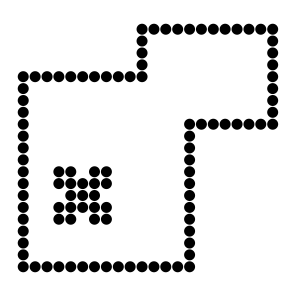
Organization makes a system of many appear fewer.
> Excerpted from Pages 11-12 of my book, The Laws of Simplicity
 
The home is usually the first battleground that comes to mind when facing the daily challenge of managing complexity. Stuff just seems to multiply. There are three consistent strategies for achieving simplicity in the living realm: 1) buy a bigger house, 2) put everything you don’t really need into storage, or 3) organize your existing assets in a systematic fashion.
     These typical solutions have mixed results. At first, a larger home lowers the clutter to space ratio. But ultimately, the greater space enables more clutter. The storage route increases the amount of empty space, but it can be immediately filled in with more stuff that will need to go into storage. The final option of implementing a system takes the form of things like closet organizers, that help bring structure to the chaos as long as the organizing principles can be obeyed. I find it compelling that all three clutter-reducing industries—the real estate market, easy storage services such as Door to Door, and rational furnishing retailers like the Container Store—are booming.
     Concealing the magnitude of clutter, either through spreading it out or hiding it, is an unnuanced approach that is guaranteed to work by the first Law of reduce. There are only two questions to ask in the de-complicating procedure: “What to hide?” and “Where to put it?” Without much thought and enough hands on deck, a messy room becomes free of clutter in no time, and remains so for at least a few days or a week.
     However, in the long term an effective scheme for organization is necessary to achieve definitive success in taming complexity. In other words, the more challenging question of “What goes with what?” needs to be added to the list. For instance in a closet there can be groupings of like items such as neckties, shirts, slacks, jacket, socks, and shoes. A thousand-piece wardrobe can be organized into six categories, and be dealt with at the aggregate level and achieve greater manageability. Organization makes a system of many appear fewer. Of course this will only hold if the number of groups is significantly less than the number of items to be organized.
 
This entry was posted on Sunday, July 23rd, 2006 at 4:34 pm and is filed under laws, 2/ organize. You can follow any responses to this entry through the RSS 2.0 feed. You can skip to the end and leave a response. Pinging is currently not allowed.

67 Responses to “Law 2: Organize”


  1. The tendency of a bigger house to cause more clutter is pretty well understood. Now if only traffic engineers understood that adding more lanes just causes worse traffic. It’s like contending with obesity by purchasing a longer belt.


  2. Needing to take an inch off of my trousers (not by dieting but because I bought the wrong size), I can certainly simplify with your belt analogy.


  3. If by organisation, we are talking about aggregation of related objects, I think abstraction is a similar, but potentially more powerful, concept.

    I don’t need to worry about how my clean socks are organised, for example, because I know they’re in my sock drawer. Now I only need concern myself with the (less flexible) interactions between me and the sock drawer rather than with individual socks. (It also makes them easier to count, which I see as a hint that it’s a useful abstraction.)

    Somewhat related to abstraction are metaphor, allegory and approximation. When applied helpfully, each allows us to work at a higher level by being able to ignore underlying complexity.


  4. Thanks Andrew, yes, “abstraction” is a good way to frame the entire space of simplicity. It represents the fact that you know where your socks are, thus you do not have to open each drawer to find them. Abstractions work best when they are tacitly understood. Seems kind of odd that abstractions have to be concrete … sort of an oxymoron to mull over on a lazy Saturday :-)


  5. You’re missing one thing; “get rid of it!” I can organize my closet as much as I want but until I get rid of those six-year old shirts that I never wear I won’t have room at all. Same with most of the things I have. I you don’t use it, give it to someone who will, or if it’s no good, recycle it or throw it out.


  6. If I remember correctly, SLIP was part of Organize, and in it you made some comment related to the fact that organization doesn’t create simplicity when the number of categories begins to approximate the number of items being organized.

    As I was organizing my thousands of PDFs of journal articles the other day, I was combining like articles in folders, creating a nice little hierarchy to make my sorting and finding of articles more efficient (even though the use of Spotlight probably makes my nice folder structure obsolete). When I was done, I looked at the hierarchy and noticed that some folders (labeled with the common content subject of the articles they contain) had only one or two PDFs, leading me to wonder whether at that level having a folder to contain those few items is more or less simple? While it creates more structure, which I feel is inherently less simple, it also appears to reduce complexity by hiding the actual PDF files.

    So, my question is this: is there a widely-accepted rule of thumb for how many items should be in a group in order that it ultimately simplifies (as opposed to creating more mental/physical overhead?) I’m sure, for example, that professional organizers, must have some feeling for this as well.

    Would you simplify a video camera’s menus by making a folder for two items? Or would it have to be at least three? or four? Or would you just avoid the question by invoking Reduce? Maybe I have too many journal articles…

    (Alas, I also just discovered that the power of the Tab key doesn’t work in web forms, where the tab key moves me to the next field. Well, I tried! I’ll resort to using line breaks)


  7. Hi John! The last sentence of this post reminded me of a chapter title in Jorge Wagensberg’s wonderful “El Gozo Intelectual” (”Intellectual Joy”): “El mundo es inteligible porque no puede haber mas arboles que ramas” (”The word is intelligible because there can’t be more trees than branches”).

    Cheers and thanks for making your laws and keys available! (My favorite, btw, is Key #1).


  8. That’s a great one Elzr. I can read Spanish so it made it even more enjoyable. Muchas Gracias, John


  9. wow, this is a good topic. i find myself wondering about how to organize things in my room and on my drive nearly on a daily basis.

    now, i realized that the most complex thing in organizing is to actively realize the moment in time when you have gathered enough stuff of mutual content to have it collectively labeled in your head, to then move it to some kind of folder.

    i always find this process very interesting: you stumble into a topic and just browse around, then some documents start lying around on your drive/ floor/ desktop for a few days, sometimes weeks, and then, at some point, (for instance while cleaning up your room) you realize, wow, some of this stuff fits together: it all deals with xyz: let’s make a new folder for it!

    at that very moment the topic often becomes tangible to me for the first time and i feel like suddenly being offered the opportunity to decide what to do with it, because the whole thing has a name now and thus has become accessible at will (i.e. google, conversations, books..)

    sometimes i don’t even know the name of the topic and instead enter all its instances i have lying around into google to find a topic name to group them by, or even to be able to do better searches by adding the genre/topic name to my queries.

    i’ve actually just gotten aware of the existence of this whole process a few months ago and i was impressed (and a bit self ashamed) about how complex all that organizational meta-thinking about one’s life has gotten over the past years. sites like lifehacker etc. deal with all that stuff a lot and i think it’s all due to some sort of fascination with being on the meta-level, looking from a distance at others as well as yourself.

    in a technological context however, i have for long been wondering how long it will take until operating systems really will start helping you with all that organizational stuff via metadata, sql-ish query filesystems, priorization of data, expiry dates, version tracking and ideas like that. currently it seems to me that all the offline-thinking done in those fields (from GTD to simplify, lifehacker to ikea ) is far ahead of everything that’s happening in the digital domain. maybe because inefficiency in square meters is more costly than it is in megabytes..

    funny, innit?

    i’m really interested in all this stuff (topic name still missing here). if someone has any good hints on what to read about it, or just wants to drop me a line, don’t hesitate to do so!


  10. Joe: with regard to the number of categories c for n things, I have a suspicion that the closer c is to sqrt(n) the more useful it is. From an information theoretic perspective, this is equivalent to a balanced c-ary tree of depth 2.

    However, for things you treat as identical (5mm ball bearings, pairs of black socks, blank Post-It notes) you can have more items in a given category because any one will suffice: you’ll never be looking for a particular 5mm ball bearing.


  11. Enjoying the blog very much, John, thanks.

    I am a great fan of Google’s technologies and use it as much as I can. I’ve noticed, though, that it has made me completely lazy about organizing of digital media. As long as the file has a name, subject line or some other descriptive meta data (and sometimes not even that is necessary), my Google Desktop or Google search can find it quickly. So now I *could* just fling files about willy nilly – just dump everything into “Documents”… but old habits die hard and I just *feel better* stuffing common project files into a folder.

    On a number of Web2.0ish sites, I have a similar experience. For example, my tasks don’t need to be stored in coherent lists around topic; i.e., “Operations” or “Marketing”. I can keep them in a single list and just TAG them with keywords. Then to see my Marketing items, I simply filter by that Tag. I’ve come to realize that tags are actually more useful than folders: I can categorize a single item with multiple tags so that different filters and searches can find the same item. For you GTD fans, this means tagging a single item with a context (”@home”) and a topic (”repairs”).

    I originally worked this out for myself on email clients. I was a fanatic filer of email into folders. I came to realize that it was a big waste of time. Better was to tag the email with tags (”Categories” in MS Outlook, for example). Then I can search on a category and presto find all the relevant messages. So now all my email is in my Inbox.

    One regret is that I can’t make this work for the physical world. My attempts to tag socks to make matching easier has not worked!


  12. Great blog and great summary of your book. Its an interesting observation you make that the 3 industries that support amassing more stuff are booming. It is certainly true for 2 out of the 3 but I would beg to differ about the current Real Estate market. Who knows, maybe the sub-prime mortgage crisis will lead to more people adopting your simplicity principals.


  13. I think it is also important for us humans to be less lazy. If I organize all the clutter in my house and arrange all my clothes in neat categories in my cupboard, it also means that searching for a particular cloth the next time requires more time than simply yanking it off the hangar. The same applies to getting up from a cosy TV position to switch on the fan, or drinking water from a glass instead of from the bottle directly.

    If someone from 200 hundred years back were to appear here today, he would be astonished at the convenience we now live in and the laziness we have developed. Personally, I would prefer to have an organized desk/house and get up to do anything, than have everything at arm’s length but a messy place.


  14. You say: There are three consistent strategies for achieving simplicity in the living realm: 1) buy a bigger house, 2) put everything you don’t really need into storage, or 3) organize your existing assets in a systematic fashion.

    But what about exercising restraint in acquiring? Giving away surplus? Rethinking the thingyness of modern life? Not living beyond our means (= saving rather than borrowing)?


  15. The suggestions of bigger house, storing stuff, and organizing systematically relate to Law # 2, organize.

    Your suggestions, restraint in acquiring, giving away surplus, and saving money would, I think, fall under Law #1, Reduce… reduce the acquisition of stuff, reduce the amount of existing stuff, and reduce spending.


  16. I love your book, and am trying to find the tool you mention in the “Organize” chapter that helps the reader through the exercise of prioritizing/clustering. I cannot find it on the site.
    Many thanks, Todd B.


  17. Hi Todd, It’s right here:

    http://www.lawsofsimplicity.com/slip1B/

    Best,
    John


  18. thnak you from


  19. But what about exercising restraint in acquiring? Giving away


  20. tahnk you stm tr türkiye nakliyat door do moving


  21. Talk about the home being a battleground, that is something that can tear a family apart, but very good article.


  22. thank you.


  23. Thank you too. JM


  24. Thanks for this nice article!


  25. Thanks for this nice article!


  26. very nices article…


  27. tahnk you stm tr aslanlar evden evenakliyat door do moving


  28. thansk you


  29. tahnks you


  30. tahnk you stm tr ankara evden evenakliyat door do moving


  31. tahnk


  32. oww very good.


  33. come very good


  34. good like thanks


  35. for performance thanks


  36. thanks you for performance !


  37. thanks for


  38. and reklam; yanlızca gazete ilan ve reklam sektöründe hizmet vermekte olup halen Türkiye genelinde yayın yapan bütün gazeteler ile resmi statüde anlaşmalı reklam ajansıdır.


  39. thanks for performance


  40. Özel ders sayesinde zaman en verimli şekilde değerlendirilir. Derslerden kaytarma ortadan kalkar ve etkin öğrenme gerçekleşir. Özel ders sayesinde bir çok konuyu çok kısa bir zaman zarfında bitirebilirsiniz.

    özel ders, birebir ders, özel öğretmen, matematik dersi, türkçe ders, ingilizce ders, özel hoca,paralı ders, ankara,evde ders


  41. http://www.sogancioglu.com.tr/
    Soğancıoğlu, İnşaat sektöründe 1996 yılından beri pek çok başarılı proje ve uygulamaya imza atmaktadır.


  42. http://www.evdenevenakliyatcilik.com/
    Evden eve taşımacılık sektöründe 16 yıldır durmaksızın hizmet veren şirketimiz 1993 yılında ankarada faliyete başlamıştır.


  43. Firmamız 1992 yılında “ASLAN PAZARLAMA” adı altında İSTANBUL da kuruldu. 1996 yılında şirketleşerek ofis kırtasiye malzemeleri liderdir


  44. thanks admın


  45. evden eve nakliyat evden eve evden eve taşıma istanbul evden eve nakliyat


  46. evden eve nakliyat evden eve nakliyat evden eve taşıma evden eve nakliye istanbul evden eve nakliyat


  47. evden eve nakliyat evden eve nakliyat istanbul evden eve nakliyat evden evev taşıma


  48. evden eve nakliyat nakliyat evden eve evden eve taşıma istanbul evden eve nakliyat.www.yazicioglunakliyat.com.tr


  49. METAL AHŞAP MOBİLYA AKSESUAR SAN. LTD. ŞTi 2000 yılında girdik. size en iyi hizmet veren firmalar arasında referans müşteri
    potansiyeli en fazla olan firma durumundayız.


  50. Hürriyet gazetesi resmi reklam ajansınız, Hürriyette Gazete reklamı, eleman,
    emlak, işçi, vasıta, duyuru reklamı vermek artık çok daha kolay ve ucuz.


  51. 2001 den beri sizlere temizlik hizmeti vermektedir. Temizlik Şirketiniz olarak yıllardır kaliteden ödün vermeden ev temizliği, ofis temizliği , inşaat sonrası temizlik haşere ilaçlama gibi birçok temizlik hizmetinde sizkerle birlikte olduk.


  52. http://www.ermodyapi.com/
    Kabin, Konteyner,Prefabrik Ev, Bekçi Kulübesi,Polyester Kabin,Güvenlik Kabini , kabin, wc, duş,tuvalet kabini, metal konteyner, duşa kabin, duş kabin,su deposu


  53. 2001 yılından günümüze güven, disiplin ve istikrarla hizmet veren Mesa Reklam, sektöründe geniş ürün yelpazesi,

    profesyonel hizmet anlayışı ve 2500’ü aşkın müşterisiyle, sektörünün önde gelen kuruluşları arasındadır.


  54. Ankarada Nakliyat sektörünü gazete ilanlarıyla yön veren Nakliyat vitrini ile ankara evden eve nakliye ve , Türkiye genelinde nakliye hizmeti veren firmalara hizmet sunmuştur.


  55. Paslanmaz Korkuluk Firmamız Paslanmaz Dekorasyon ve Pirinç Pleksi Dekorasyon işleri ile hizmet vermektedir.


  56. Paslanmaz KUpeste OLarak paslanmaz mağaza standları ve mağaza cephe giydirmeleri imalatlarının yanı sıra, paslanmaz korkuluklar, küpeşte, paslanmaz dekorasyon, paslanmaz merdiven korkuluk bağlantı elemanları, havuz yanı cam korkulukları, paslanmaz bayrak direkleri, aydınlatma armatürleri, paslanmaz bariyer, Pirinç Merdiven Korkulukları, paslanmaz küllükler, Pirinç Karyolalar, paslanmaz kolon giydirme, paslanmaz saçak ve Pleksi Korkuluklar imalatları yapmaktadır.


  57. Paslanmaz Cagdas Firmamız Paslanmaz Dekorasyon ve Pirinç Pleksi Dekorasyon işleri ile hizmet vermektedir.


  58. Çağdaş Paslanmaz olarak paslanmaz metal ve pirinç dekorasyon sarı korkuluk işleri ile hizmetinizdeyiz.


  59. Firmamız inşaat firmalarına metal uygulamaları hususunda hizmet vermek üzere kurulmuştur. Kuruluşundan bu yana gerek inşaat firmaları gerek son kullanıcılara hizmet veren firmamız müşterilerinden aldığı güçle yatırımlarını artırmış, daha geniş bir müşteri kitlesine ulaşma çabası içerisine girmiştir. Cagdas paslanmaz çelik merdiven korkulukları, paslanmaz çelik merdiven ve balkon korkulukları, ferforje, alüminyum korkuluk sistemleri, camlı pleski pirinç korkuluk uygulamaları,sarı pleksi merdiven korkuluk panel kaplamalar yapmaktadır.


  60. Firmamız 1987 yılında Pendik / İSTANBUL ‘ da Türk Sanayi’isine çelik konstrüksiyon ve vinc imalatları ile destek vermek üzere

    kurulmuştur. Vinçmaksan kurulduğu günden buyana kaliteli hizmet anlayışıyla rakiplerinede örnek olmuştur.


  61. Sayfamızda seri ilan ve çerçeveli ilanlar hakkında örnekler, açıklamalar, teknik bilgiler,
    fiyatlama ve kampanya bilgilerini bulabilir gazete ilan servisi iletişim bilgilerine ulaşabilirsiniz.
    Tüm gazetelere ilan alınır


  62. 1966 yılında tarihi eser restarasyonu işinde mermercilik sektörüne geçen saygı deger babamız Raşit Reyhanın mermercilige adım atması ile babadan geçebileçek olan meslek serüvenimiz bizide o günlerden mermercilige devam etmemize önder oldu.


  63. Müşterilerzimize sunduğumuz süreli hizmetlerimiz, yapılan bakım ve onarım Anlaşmaları ile sağlanır.


  64. İnşaat sektöründe edindiğimiz teknik tecrübenin ışığında ,mobilya, konveyör ve taahhüt
    işleri de yapmaktayız.Bu sektörlerde de yerimizi almış bulunkatayız.


  65. Bilgisayar Servisi Ankara, Bilgisayar Bakım ,Teknik Servis,VeriKurtarma, Printer Tamiri,
    laptop notebook tamiri, Ağ bağlantısı tamiri,Ağ bağlantısı sözleşmesi Müşterilerzimize sunduğumuz süreli hizmetlerimiz, yapılan bakım ve onarım Anlaşmaları ile sağlanır.


  66. Camların katlanarak aynı noktaya toplanabilme özelliği nedeni ile mevsimsel değişikliklere en iyi cevap verebilen bir sistemdir.


  67. Halı temizliğinde ankarada isim yapmış hitit halı yıkama profesyonel hizmetleriyle

    müşterileri memnun etmekteir.

Comments Area

NOTE: I reserve the right to edit or delete inappropriate comments. But I'm also a believer in free speech. Keep it simple.

(required)