






» Visit the new RISD blog
»
CONTEXT
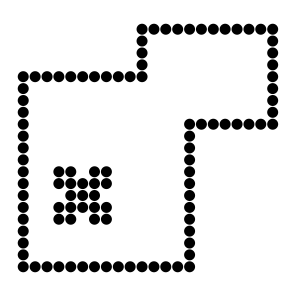
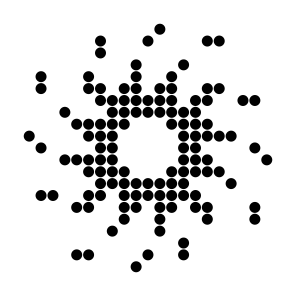
What lies in the periphery of simplicity is definitely not peripheral.
This entry was posted on Sunday, July 23rd, 2006 at 4:37 pm and is filed under laws, 6/context. You can follow any responses to this entry through the RSS 2.0 feed. You can skip to the end and leave a response. Pinging is currently not allowed.

9 Responses to “Law 6: Context”


  1. Things are not always what they seem.


  2. It makes sense when I think deep, but when I try to explain it seems it should be

    What lies in the periphery of simplicity is definitely not Simple (peripheral).


  3. Dr Gross> I don’t think the simplicity of what is at the peripheral is what this rule is concerned about.

    If something is “close” to the core, then “it must have something to do with it”, hence, what surrounds simplicity must be *important*. This is my interpretation. :)


  4. Hey Johan

    I have concluded the meaning of this law as follows.

    What looks simple (appearing in the periperhy of simplicity) is defintly not simple because there is alot more to it then what meets the eye(peripheral).

    Examples could be any show of talent, wrestling, yo yo’ng, or a website that looks very clean and simple, break down the code and it may not be the case.


  5. Dr Gross. I think you’re overanalizing this.

    I think that the point is that simplicity can be achieved by creating a context to embrace it.

    Apple’s remote is extremely simple: five buton navigation, plus one button that works both as a startup and as an exit button. In it’s periphery we have Front Row, which allows the remote to be simple by giving a simple interface (or context) in which to exist. Take that remote and give it a Windows interface and it’s no longer simple because it’s surrounded by a context that doesn’t complement it (it would probably have too many menu options that would be hard to navigate with a five button remote, and then you would have to go through multiple screens and levels, hence you’d need a more elaborate and complex remote).

    You’re talking about “divide and conquer” (very commonly used in programming, which could explain your code example), or maybe even about hiding reality.


  6. context - what holds story together… embrace = engaged


  7. Nice. Thanks, John


  8. thanks


  9. Let’s differentiate between beneath and surronding.
    What i interpret is that the surface or problem you are trying to simplify depends a lot on the surronding. We need deep understanding of the surrounding to
    1. Help us know the current limitations imposed by surrondings.
    2. We can be influenced by surrounding.
    3. We can make use of any breakthrough in surronding to achieve next level of simplicity.

Comments Area

NOTE: I reserve the right to edit or delete inappropriate comments. But I'm also a believer in free speech. Keep it simple.

(required)