

» Visit the new RISD blog
»
I’m Slip-ping
Picture 4.png

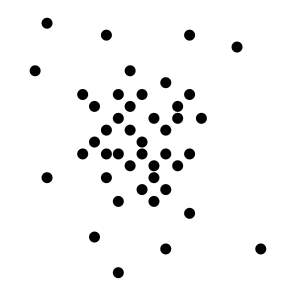
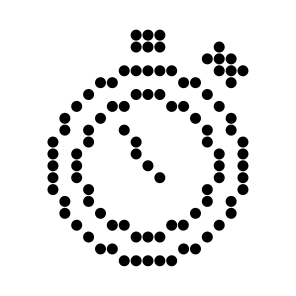
The SLIP (Sort Label Integrate Prioritize) tool I’ve provided here is something I’ve begun to use daily online instead of using the little Post-it notes that litter my desk. When implementing this system I thought of doing it with more exotic animations and advanced UI-techniques, which indeed I did some experimentation with. However in the end I put aside ideas of elegant interface designs for what simply worked. This exercise made me realize how failure can occur in either design or execution. In the end we have to choose which failure in attempting to achieve simplicity that we’re willing to stomach. The bottle of antiacid next to my computer helps to temper the reality of finding the right compromise.

Mixed Signals

Matt and Jason of 37signals have posted a “fireside chat” of a 4-way conversation with the two 37signal-ers and my favorite IDEO designer Diego Rodriguez.

Business Takes Simplicity
IMG_0051.JPG

I saw this copy in a magazine ad for VISA: “Business takes Simplicity.” The subsequent punchline for the ad is “Life takes Visa.” I’m not sure what this means. Perhaps the intent is to equate simplicity with VISA through the parallel construction of the copy?

Simplicity Symposium: Part 5
gary.jpg

Hong Kong-based architect Gary Chang showed this grainy picture of a “cageman” house. The structure is a low-cost unit that measures 1-meter by 2-meters where each unit is stacked vertically in a warehouse-like enclosure. There is no privacy as part of the living style of the cagemen, and naturally their belongings are pared down to only the barest of essentials a la reduce. Gary says that the inhabitants prefer living in the cages over regular living units because the spaces have the value of constant social interaction–surprisingly the cost difference to rent a cage versus a small flat is not significant.

Gary scored a bit hit with the design of his suitcase house built near the Great Wall. This building is a single story structure where when you walk in, all you see is a simple floor stretched across the entire building with no walls. The trick is that the floors fold and flip to reveal a kitchen, bath, bedroom and other components in the spirit of hide as developed in the first Law.

Describing his own tiny flat, Gary showed how he creates space on-demand by reconfiguring the elements based upon the time of day. For instance, he has a huge bed, that folds up to make space for his dining area with a kitchen that swings out, and then when finished eating he pops open his work space and then by the evening his projection TV screen unfurls with all other elements stowed away to create a personal theater. At the end of the day, everything vanishes and his bed folds out to continue the active cycling of his immediate living realm. It all looked quite simple to the audience, but by virtue of Gary’s subtle mastery of the art of context.

If in Washington DC

The Laws of Simplicity is featured this week on display at Olsson’s book store at Reagan National Airport / Terminal C in Washington DC. I feel oddly patriotic in a commercial kind of way …