



» Visit the new RISD blog
»
Oh! Simplicity

I spent yesterday with a talented group of folks at the only women-owned and operated television network in the world, Oxygen Media. The topic was simplicity in the context of digital media and as usual when I have the opportunity to speak on the topic, compared to what I give to a community I get back a great deal more by carefully listening.

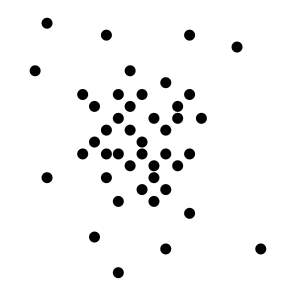
The 6th law of context struck me as particularly relevant during our conversations. There were a few variants to the 6th law that never made it to the final cut, but even in its final form I felt it didn’t encapsulate what I wished to express. Because I’m unafraid of failure it of course stands in its current form. But at Oxygen, when I listened to their designers’ approach of designing media for women as necessarily “off-target instead of 100% on-target” I was thrilled to learn more. Their point was something to the effect that if you design something that is exactly tailored and targeted to a specific segment, then the segment will run away from it as what they’re looking for is something slightly off-target. This doesn’t seem intuitively obvious, but makes a great deal of sense. There’s a certain minority that can be hit with pinpoint accuracy, but in general we humans love to be slightly individualistic. Subtle differences are always important to us.

So in summary, I learned that when your on, you’re off; and when you’re off, you might be on. Which brings me to one of the original constructions of the 6th Law, “The situation around you, often matters more than what stands directly in front of you.” Yes it’s a bit off, but maybe it’s a bit more on. I hope you take off with something fun for the weekend.

A Tiny Step Forward
07_tiny.gif

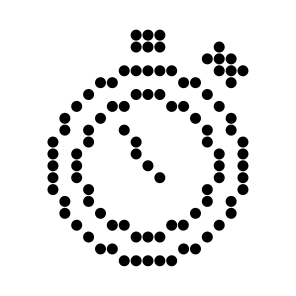
Luis Blackaller and Brent Fitzgerald have released a new Mac OS X Dashboard Widget to play with their “Tiny Icon Factory.” There’s a lot of expressive space in the tiny confines of a 13 by 13 pixel grid. It can really be quiet addictive. Be careful.

Free Money
Picture 47.png

When I saw Google yesterday offering a free 10 dollars for the taking, it reminded me of an experiment on trust by my wacky friend Prof. Dan Ariely. He did an experiment where he set up a table in a public space with a bowl containing cash and a sign that said, “Free Money.” Dan found that with a pile of one-dollar bills, 10% of the passerbys would stop and take the cash; with fifty-dollar bills, only 22% took him up on his offer. His point was that “If someone is offering me something free, there must be a trick to it.”

We can be cynical in life, and assume that there really is no thing as a totally “free lunch.” To complete mis-trust everything around you can probably lead to a lonely state of being. Well, in another browser window there I am about to “Sign up to earn [my] $10 bonus.” Free money is only a click away.

Who You Gonna Trust …

A friend pointed me to the Stanford Guidelines for Web Credibility. As an advocate of trust as an important property of simplicity, I thought this list to be quite relevant. Then I began to wonder about the distinction between the words trust and credibility. For some reason, I think of the word credibility as less credible than trust. That distinction may not be important.

Going through the “Ten Laws of Credibility,” I find that they all make a great deal of sense and I see ways by which I can improve this site’s credibility, as well as others I am working on. I like how the page itself embodies its own rules to a high degree. As to whether then by design you are more likely to trust me or not that remains to be determined if I am to go ahead and implement the Stanford guidelines. Perhaps I can get to it once I have more time.

More Deskpats versus Less

I had promised to add more desktop pattern images over winter break but my break never came. Since I was taking so long, reader/designer Bert Mahoney sent me a few desktop patterns to help me finish this task. My fonts were different so I went and did a few more thanks to Bert’s encouragement.

 
Desktop pattern for a normal 4:3 aspect ratio screen (~50kb).

 
Desktop pattern for a 16:9 widescreen (~50kb).

The Third Law time expresses the importance of watching (or at least enjoying) one’s springs.

 
Desktop pattern for a normal 4:3 aspect ratio screen (~50kb).

 
Desktop pattern for a 16:9 widescreen (~50kb).

As I am a fan of all forms of education, my favorite Law remains the Fourth Law learn.

 
Desktop pattern for a normal 4:3 aspect ratio screen (~50kb). [hc]

 
Desktop pattern for a 16:9 widescreen (~50kb). [hc]

In the Fifth Law differences I mean to express that if there’s a yin, there’s a yang.

 
Desktop pattern for a normal 4:3 aspect ratio screen (~50kb). [hc]

 
Desktop pattern for a 16:9 widescreen (~50kb). [hc]

Keep your eye off the road to become aware of the Sixth Law context, but try not to forget where you’re going.

PS Bert selected the colors for Law 3 and Law 4 for me in the examples he had sent. That certainly made it easy for me. Not having to think–that’s real simplicity. Thank you Bert!