




![]() |
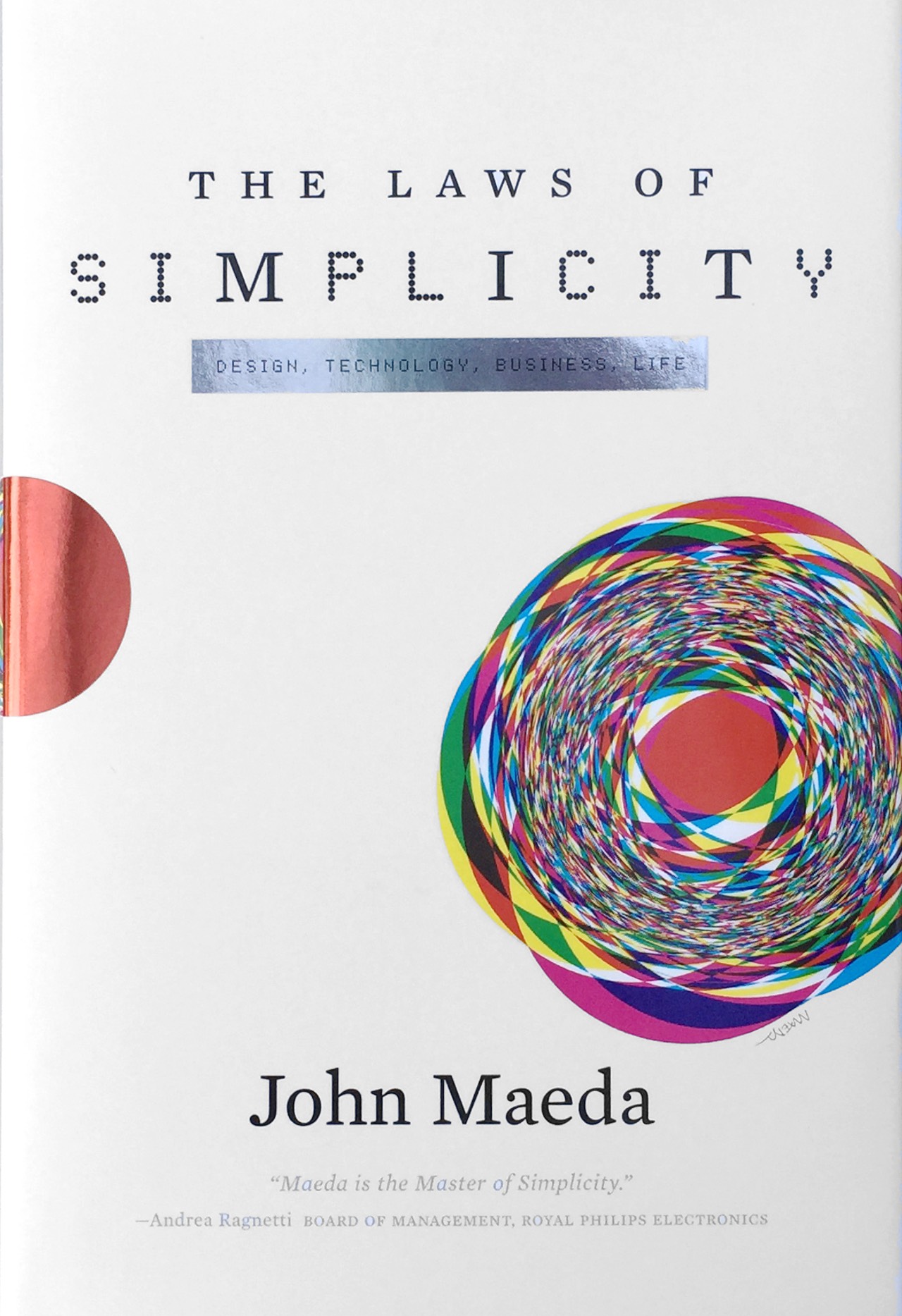
I wrote The Laws of Simplicity in late 2005 to early 2006 to get my thoughts down about simplicity. In the course of 100-pages, I outline the Ten Laws as used on this website. |

The simplest way to achieve simplicity is through thoughtful reduction.
> Excerpted from Page 1 of my book, The Laws of Simplicity
The easiest way to simplify a system is to remove functionality. Today’s DVD, for instance, has too many buttons if all you want to do is play a movie. A solution could be to remove the buttons for Rewind, Forward, Eject, and so forth until only one button remains: Play.
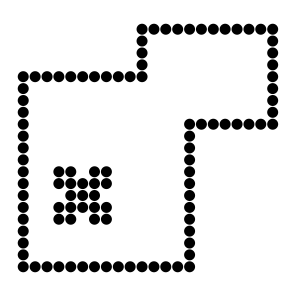
But what if you want to replay a favorite scene? Or pause the movie while you take that all-important bathroom break? The fundamental question is, where’s the balance between simplicity and complexity?
|
How simple can you make it? |
![]() |
How complex does it have to be? |
On the one hand, you want a product or service to be easy to use; on the other hand you want it to do everything that a person might want it to do.
The process of reaching an ideal state of simplicity can be truly complex, so allow me to simplify it for you. The simplest way to achieve simplicity is through thoughtful reduction. When in doubt, just remove. But be careful of what you remove.

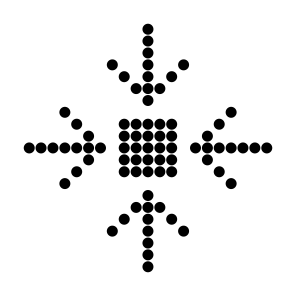
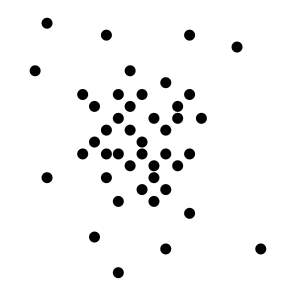
Organization makes a system of many appear fewer.
> Excerpted from Pages 11-12 of my book, The Laws of Simplicity
The home is usually the first battleground that comes to mind when facing the daily challenge of managing complexity. Stuff just seems to multiply. There are three consistent strategies for achieving simplicity in the living realm: 1) buy a bigger house, 2) put everything you don’t really need into storage, or 3) organize your existing assets in a systematic fashion.
These typical solutions have mixed results. At first, a larger home lowers the clutter to space ratio. But ultimately, the greater space enables more clutter. The storage route increases the amount of empty space, but it can be immediately filled in with more stuff that will need to go into storage. The final option of implementing a system takes the form of things like closet organizers, that help bring structure to the chaos as long as the organizing principles can be obeyed. I find it compelling that all three clutter-reducing industries—the real estate market, easy storage services such as Door to Door, and rational furnishing retailers like the Container Store—are booming.
Concealing the magnitude of clutter, either through spreading it out or hiding it, is an unnuanced approach that is guaranteed to work by the first Law of reduce. There are only two questions to ask in the de-complicating procedure: “What to hide?” and “Where to put it?” Without much thought and enough hands on deck, a messy room becomes free of clutter in no time, and remains so for at least a few days or a week.
However, in the long term an effective scheme for organization is necessary to achieve definitive success in taming complexity. In other words, the more challenging question of “What goes with what?” needs to be added to the list. For instance in a closet there can be groupings of like items such as neckties, shirts, slacks, jacket, socks, and shoes. A thousand-piece wardrobe can be organized into six categories, and be dealt with at the aggregate level and achieve greater manageability. Organization makes a system of many appear fewer. Of course this will only hold if the number of groups is significantly less than the number of items to be organized.

Savings in time feel like simplicity.
> Excerpted from Pages 23-24 of my book, The Laws of Simplicity
The average person spends at least an hour a day waiting in line. Add to this the uncountable seconds, minutes, weeks spent waiting for something that might have no line at all.
Some of that waiting is subtle. We wait for water to come out of the faucet when we turn the knob. We wait for water on the stove to boil, and start to feel impatient. We wait for the seasons to change. Some of the waiting we do is less subtle, and can often be tense or annoying: waiting for a Web page to load, waiting in bumper-to-bumper traffic, or waiting for the results of a dreaded medical test.
No one likes to suffer the frustration of waiting. Thus all of us, consumers and companies alike, often try to find ways to beat the ticking hand of time. We go out of our way to find the quickest option or any other means to reduce our frustration. When any interaction with products or service providers happens quickly, we attribute this efficiency to the perceived simplicity of experience.
Achieving notable efficiencies in speed are exemplified by overnight delivery services like FedEx and even the ordering process for a McDonald’s hamburger. When forced to wait, life seems unnecessarily complex. Savings in time feel like simplicity. And we are thankfully loyal when it happens, which is rare.

Knowledge makes everything simpler.
> Excerpted from Pages 33-34 of my book, The Laws of Simplicity
Operating a screw is deceptively simple. Just mate the grooves atop the screw’s head to the appropriate tip—slotted or Phillips—of a screwdriver. What happens next is not as simple, as you may have noted while observing a child or a woefully sheltered adult turning the screwdriver in the wrong direction.
My children remember this rule through a mnemonic taught by my spouse, “righty tighty, lefty loosy.” Personally I use the analogy of a clock, and map the clockwise motion of the hands to the positive penetration curve of the screw. Both methods are subject to a second layer of knowledge: knowing right versus left, or knowing what direction the hands of a clock turn. Thus operating a screw is not as simple as it appears. And it’s such an apparently simple object!
So while the screw is a simple design, you need to know which way to turn it. Knowledge makes everything simpler . This is true for any object, no matter how difficult. The problem with taking time to learn a task is that you often feel you are wasting time, a violation of the third Law of time. We are well aware of the dive-in-head-first approach—“I don’t need the instructions, let me just do it.” But in fact this method often takes longer than following the directions in the manual.


(39)