Simplicity and complexity need each other.
> Excerpted from Pages 45-46 of my book, The Laws of Simplicity
Nobody wants to eat only dessert. Even a child that is allowed to eat ice cream three meals a day will eventually tire his sweet tooth. By the same token, nobody wants to have only simplicity. Without the counterpoint of complexity, we could not recognize simplicity when we see it. Our eyes and senses thrive, and sometimes recoil, whenever we experience differences.
Acknowledging contrast helps to identify qualities that we desire—which are often subject to change. I don’t personally prefer the color pink, but I do like it as a dash of brightness in a drab sea of olive green. The pink appears bold and vibrant as compared with its dark and muted surroundings. We know how to appreciate something better when we can compare it to something else.
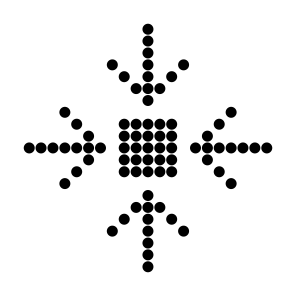
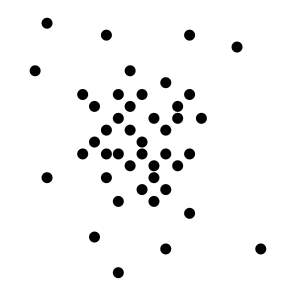
Simplicity and complexity need each other. The more complexity there is in the market, the more that something simpler stands out. And because technology will only continue to grow in complexity, there is a clear economic benefit to adopting a strategy of simplicity that will help set your product apart. That said, establishing a feeling of simplicity in design requires making complexity consciously available in some explicit form. This relationship can be manifest in either the same object or experience, or in contrast with other offerings in the same category—like the simplicity of the iPod in comparison to its more complex competitors in the MP3 player market.


Law 4: Learn
Law 6: Context
14 Responses to “Law 5: Differences”


complexity can’t eat simple. but the simple can eat complexity. that means simple has more agressive face.
‘Simplicity and complexity need each other.’
simplicity can live by its own. complexity need to be simplified.
Simplicity wears global character. That is attractor.
That’s a neat idea — to ask whether one can cancel out the other, and whether that relationship is reciprocal. I’ll have to think for a while about your answer, but the question is powerful and can apply to anything in life. A nice way to start off 2007 tobto!
Just curious why the icon for Differences is a duck? It made me think of the classic riddle: “What is the difference between a duck?”
Joe, It’s actually a goose. Duck duck goose.
John
One definition of chaos (I can’t remember which book it came from) is “a mixture of complexity and ignorance”. There is order in complexity and if this complexity overwhelms our senses, the chaos of our minds take over. So chaos is complexity that we find difficult to comprehend.
Being able to see the order behind complex systems allows us to define the systems essence, which we can then apply to the design of useful and/or beautiful systems (simple or otherwise). This process helps us to appreciate the complex system that may have initially overwhelmed our senses.
Complexity + Ignorance = Chaos … thank you for solving the puzzle for us Chris. As a person that feels ignorant every day, I’m glad to know it’s a natural part of the chaos of life. Best wishes, John
If, by definition, complexity = something which can be simplified, then I prefer the word “sophistication” over complexity with regards to what is complex, yet unsimplifiable (or a mixture there of).
Entropy can be thought of as the tendency for complexity to grow with time automatically. Hence, although simplicity may “eat” complexity, complexity naturally grows with time.
Complexity helps you to understand the link between the events and aboid simples explanations (generally wrongly interpreted). Simplicity helps you to dosify the emplanation to all those embolved. Thanks for this great laws. If I could have some more years I think I would write them (some of them at least).
I have sometimes heard the expressions: “The Devil is in the details” and “God is in the details”. I am by no means religous, but often contemplate these two quotes.
For me, the first quote equates to the equation “Complexity + Ignorance = Chaos”, and the later quote equates to the equation “Compexity + Knowledge (or Understanding)” = Beauty. Could you please help me find the words that best simplify this equation?
Hi John,
Great speech at TEDTalks this year!!
Your designs with katakana building up a complex drawing made me realize that in fact simplificy doesn’t need complexity but complexity IS generated by simplicity.
You can see this basically not only on any architect’s design but also in fractal drawings and recursive programming.
plz. give me some information on this topic(complexity)for the purpose of makinf a report.
for this, ever i will be thankful to u.
I would suggest that the simplicity and the complexity don’t need each other but more precisely they should stand at a different level of logic.
For example, you have several features but you can use them indifferently because none of them implies one or some of them. In this case you have a graphe, otherwise it’s a tree.
A graphe presents a combinatorial more complexe than a tree but leads you everywhere, you can proceed as you want; with a tree you have to proceed accordingly. The simplicity here doesn’t belong to the logical level of the graphe or the tree, it is enabled at an other level indeed.
Comparatively the graphe enable something simpler than the tree.
I think verge separating difficult from simple is clear human phenomenon of accustoming.
I think an underlying tone of this excerpt is about “contrast” in itself. We do need contrast, don´t we?
And I agree with the “sophistication” x “complexity” idea. Complexity is synergy—often not knowledgeable, sophistication is otherwise.