




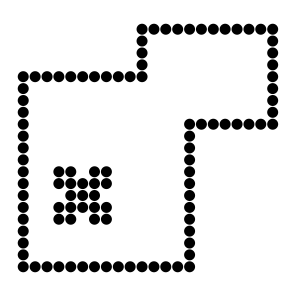



What lies in the periphery of simplicity is definitely not peripheral.

12 Responses to “Law 6: Context”
Comments Area
NOTE: I reserve the right to edit or delete inappropriate comments. But I'm also a believer in free speech. Keep it simple.
Things are not always what they seem.
It makes sense when I think deep, but when I try to explain it seems it should be
What lies in the periphery of simplicity is definitely not Simple (peripheral).
Dr Gross> I don’t think the simplicity of what is at the peripheral is what this rule is concerned about.
If something is “close” to the core, then “it must have something to do with it”, hence, what surrounds simplicity must be *important*. This is my interpretation.
Hey Johan
I have concluded the meaning of this law as follows.
What looks simple (appearing in the periperhy of simplicity) is defintly not simple because there is alot more to it then what meets the eye(peripheral).
Examples could be any show of talent, wrestling, yo yo’ng, or a website that looks very clean and simple, break down the code and it may not be the case.
Dr Gross. I think you’re overanalizing this.
I think that the point is that simplicity can be achieved by creating a context to embrace it.
Apple’s remote is extremely simple: five buton navigation, plus one button that works both as a startup and as an exit button. In it’s periphery we have Front Row, which allows the remote to be simple by giving a simple interface (or context) in which to exist. Take that remote and give it a Windows interface and it’s no longer simple because it’s surrounded by a context that doesn’t complement it (it would probably have too many menu options that would be hard to navigate with a five button remote, and then you would have to go through multiple screens and levels, hence you’d need a more elaborate and complex remote).
You’re talking about “divide and conquer” (very commonly used in programming, which could explain your code example), or maybe even about hiding reality.
context - what holds story together… embrace = engaged
Nice. Thanks, John
thanks
Let’s differentiate between beneath and surronding.
What i interpret is that the surface or problem you are trying to simplify depends a lot on the surronding. We need deep understanding of the surrounding to
1. Help us know the current limitations imposed by surrondings.
2. We can be influenced by surrounding.
3. We can make use of any breakthrough in surronding to achieve next level of simplicity.
There is no periphery - everything is intimately connected..
When reading this wonderful book, I started to think of a book I read before. Moshe Safdie wrote the book, “The City After the Automobile”. The connection comes from your law about pushing complexity away similar how we use Google with ease because we are able to tap into the location of very powerful computers centralized for us to use when we need to.
Safdie talks about getting rid of the owned car similar how Google relieves us from owning our own system of powerful computers.
What if we centralized more than just our operating systems or internet search engines? What if we started centralizing more to provide us with less? With the popular businesses like Netflix, our DVD book cases have started to make less sense. Could we bring this idea into other areas in our lives? Could we get by with a “Netflix” idea for our clothes, cars, entertainment centers, furniture, or even our homes?
(Thank you for the book. I continue to enjoy it.)
The example of this discussion provides me with the best description of this law. Law 6 = simplicity. This discussion lies at the periphery of that simplicity, but is not peripheral to it. The periphery is reactive, interactive and generative at one moment.