









» Visit the new RISD blog
»
Simplicity Symposium: Part 4
kottke.jpg

I asked Jason Kottke to talk about the creative process for how he goes about collecting information for kottke.org. Perhaps my first encounter with Jason’s name was in a magazine article about full-time bloggers. Jason is a soft spoken person and I appreciated his calm style of presentation. He began with the assertion, “There’s a lot of misinformation out there. It makes our world unnecessarily complex.” By Jason’s estimate, there is about 7.1 quadrillion bytes generated each day by newspapers all around the world. I was surprised to learn about Jason’s strong need to maintain editorial integrity by being sure to verify his posts by checking multiple sources. I gravitate to Jason’s blog for its simplicity, and I was happy to learn of his care to instill trust in his readership.

He scans about 100 online pages and 100 real pages with a requisite “one poem per day.” This latter comment was truly poetic–pun intended. But he said that his best posts are usually found randomly through serendipity. It seems that there are a variety of random URL generator sites out there which after a few casts of the die I understood Jason’s point quite clearly.

Finally, I was excited to hear that he generally blogs with “a couple longer posts with eight shorter posts.” Jason’s site feels fairly unstructured but seems to work extremely well. I didn’t realize that it was because he has a clear sense of how each post is organize-d. It is this simple combination of trust and organization that underlies his journey to “find out what the Web is saying about the world.”

Notes on the Synthesis of Form

Seminal text from the 60s about organization by visionary architectural theorist Christopher Alexander.

Law 2: Organize
ORGANIZE
Organization makes a system of many appear fewer.
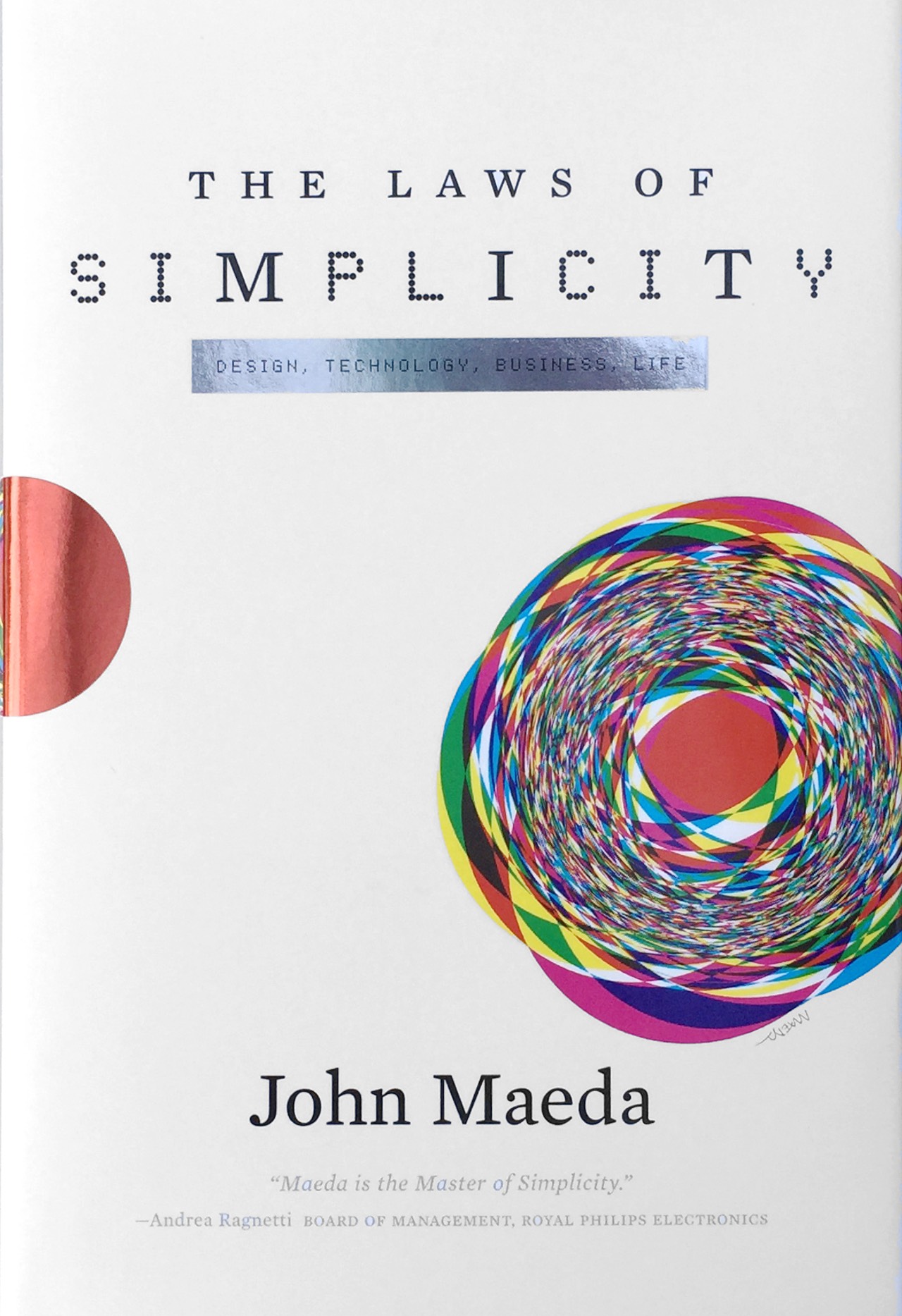
> Excerpted from Pages 11-12 of my book, The Laws of Simplicity
 
The home is usually the first battleground that comes to mind when facing the daily challenge of managing complexity. Stuff just seems to multiply. There are three consistent strategies for achieving simplicity in the living realm: 1) buy a bigger house, 2) put everything you don’t really need into storage, or 3) organize your existing assets in a systematic fashion.
     These typical solutions have mixed results. At first, a larger home lowers the clutter to space ratio. But ultimately, the greater space enables more clutter. The storage route increases the amount of empty space, but it can be immediately filled in with more stuff that will need to go into storage. The final option of implementing a system takes the form of things like closet organizers, that help bring structure to the chaos as long as the organizing principles can be obeyed. I find it compelling that all three clutter-reducing industries—the real estate market, easy storage services such as Door to Door, and rational furnishing retailers like the Container Store—are booming.
     Concealing the magnitude of clutter, either through spreading it out or hiding it, is an unnuanced approach that is guaranteed to work by the first Law of reduce. There are only two questions to ask in the de-complicating procedure: “What to hide?” and “Where to put it?” Without much thought and enough hands on deck, a messy room becomes free of clutter in no time, and remains so for at least a few days or a week.
     However, in the long term an effective scheme for organization is necessary to achieve definitive success in taming complexity. In other words, the more challenging question of “What goes with what?” needs to be added to the list. For instance in a closet there can be groupings of like items such as neckties, shirts, slacks, jacket, socks, and shoes. A thousand-piece wardrobe can be organized into six categories, and be dealt with at the aggregate level and achieve greater manageability. Organization makes a system of many appear fewer. Of course this will only hold if the number of groups is significantly less than the number of items to be organized.