



» Visit the new RISD blog
»
Pointing to the Sky
IMG_0461.JPG

Today I was in Washington DC at the White House as a Trustee of the Cooper-Hewitt National Design Museum. It is a simple affair every year with the winners of the National Design Awards and hosted by First Lady Laura Bush. There are many historical pieces of art on display at the White House, but my favorite “things” to look at are the wonderful views from the inside of the First House like the simple and enigmatic Washington Monument. I enjoyed the awkward differences in my local surrounds of the frill and fine craft of the parlour compared with the stark, skyward facing object not so far away.

The Aesthetics of Failure
IMG_15541.JPG

While traveling in Asia my tummy and eyes may have eaten too well.

In a small shop in Nishi-Nippori, Tokyo I was treated with the most delicious soba noodles I have ever tasted. As we were leaving, I noted the solid wooden tabletop with cracks that had been mended with large reinforcing pieces of a completely different kind of wood. Perhaps due to the deliciousness of the soba I hadn’t noticed the striking differences as visually posed, but as I departed it was what screamed out.

Defects are normally stamped out in a six-sigma world. If it ain’t perfect, throw it out. Perhaps as you get older, you are more tolerant of how the world presents its failure-s around you. And maybe it is then you can begin to see the beauty of that which could be dismissed as invalid or otherwise handicapped, to emerge as entirely more relevant than if it were 100.000% perfect.

More Deskpats versus Less

I had promised to add more desktop pattern images over winter break but my break never came. Since I was taking so long, reader/designer Bert Mahoney sent me a few desktop patterns to help me finish this task. My fonts were different so I went and did a few more thanks to Bert’s encouragement.

 
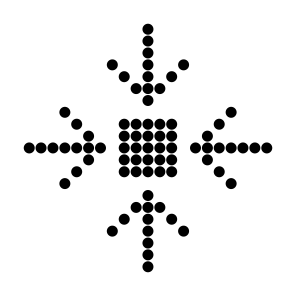
Desktop pattern for a normal 4:3 aspect ratio screen (~50kb).

 
Desktop pattern for a 16:9 widescreen (~50kb).

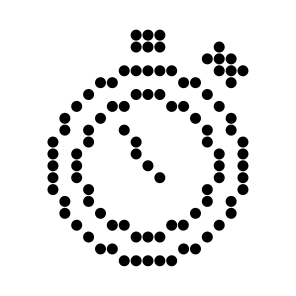
The Third Law time expresses the importance of watching (or at least enjoying) one’s springs.

 
Desktop pattern for a normal 4:3 aspect ratio screen (~50kb).

 
Desktop pattern for a 16:9 widescreen (~50kb).

As I am a fan of all forms of education, my favorite Law remains the Fourth Law learn.

 
Desktop pattern for a normal 4:3 aspect ratio screen (~50kb). [hc]

 
Desktop pattern for a 16:9 widescreen (~50kb). [hc]

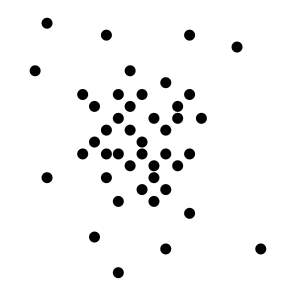
In the Fifth Law differences I mean to express that if there’s a yin, there’s a yang.

 
Desktop pattern for a normal 4:3 aspect ratio screen (~50kb). [hc]

 
Desktop pattern for a 16:9 widescreen (~50kb). [hc]

Keep your eye off the road to become aware of the Sixth Law context, but try not to forget where you’re going.

PS Bert selected the colors for Law 3 and Law 4 for me in the examples he had sent. That certainly made it easy for me. Not having to think–that’s real simplicity. Thank you Bert!

Crossing the Chasm
chasm.jpg

Much has been said about Moore’s Technology Adoption Curve and the difficulty of getting consumers to “cross the chasm” to achieve success in the marketplace. Today I was wondering whether the simplest solution to help consumers make the jump across the chasm is to just focus on ensuring that your product embodies simplicity. This may seem like a simplistic answer, but it does help to explain why products with simple operation, simple concept, simple marketing message do manage to succeed.

Perhaps the more question is what happens after the early and late majority adopts the product? Consumers bore of the simplicity of the device and desire more. Complexity is sprinkled over the product to enhance the emotion-al attachment to spice up the relationship. Does simplicity pull them in initially for the first date, and then complexity reels them in further to make for a steamy relationship?

Some stay wed to their devices/objects forever; others go looking for a new fling. differences is a good thing.

The Innovator’s Solution

Change is inevitable, so how do you be in charge or aware of the conditions when it occurs?