







» Visit the new RISD blog
»
The Illusion of Speed

IMG_4325.JPG

Whenever I travel, I am always on the lookout for the right kind of chocolate-as-a-gift. This is often a difficult choice as although the taste of the chocolate is certainly important, the packaging is often an important constraint as well. Tourist-focused chocolates might have a landmark imprinted on the package — say the Eiffel tower or Wolfgang Amadeus Mozart. Finding the right degree of authenticity is one thing I seek.

For the above chocolate bar series I was drawn to the simplicity of the packaging style. The chocolate is clearly visible and a sticker is slapped onto the transparent sleeve. I felt it was an open approach first of all because the candy was not hidden behind gold foil or what-not. And in addition I sensed that the packaging process itself was one that took very little time either to conceive or execute. My takeaway was that freshness is supported by the illusion that thoughtful haste has been applied in presentation of an object.

NYT Key Magazine
key-slide11.jpg

I did the cover for today’s issue of Key Magazine in The New York Times. The Art Director Dirk Barnett took interest in my process of creating this work, and they chose to publish my “making of” as an open approach to artmaking. In essence it’s all about how much time we have really. I wish we had more, but everyday as time passes us by, we always end up with less. Sigh.

A Tiny Step Forward
07_tiny.gif

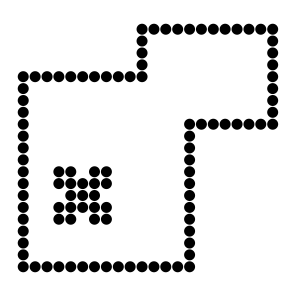
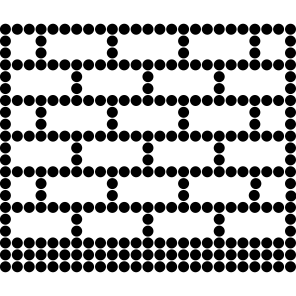
Luis Blackaller and Brent Fitzgerald have released a new Mac OS X Dashboard Widget to play with their “Tiny Icon Factory.” There’s a lot of expressive space in the tiny confines of a 13 by 13 pixel grid. It can really be quiet addictive. Be careful.

Open Source Garbage
rubbish.jpg

I lived in Tokyo when the terrible sarin incident occurred. In a clean-obsessed society like Japan, for the weeks after the attack it was difficult to manage life in the train stations without public trash cans. Officials held that the removal was necessary for safety reasons. Thus I was surprised on my recent trip to Tokyo to see the return of trash bins and their clever design.

With its see-through sides, each of the bins is subject to the collective intelligence of passersby on the train platform. This open approach thus solves the problem of regular monitoring by officials, and also increases public consciousness of waste/recycling.

Simplicity Symposium: Part 3
walterbender.jpg

Walter Bender, One Laptop Per Child (OLPC) President of Content, discussed the design details of the so-called “hundred dollar laptop.” In his presentation, Walter described the three tenets of “being human” as: 1) We learn (and teach), 2) We express, and 3) We’re social. The design of the OLPC was created with his three human tenets in mind with its: 1) pedagogy, 2) digital expression capability, and 3) the mesh networking technology that makes it more of a “local” than a “global” machine.

Power consumption was a major design constraint for the OLPC given that it’s intended audience (the Third World) does not have the luxury of a constant and reliable power source. Thus the OLPC was designed to run at 2 Watts versus the 20 Watts of an average laptop through a variety of clever engineering feats. The third Key of power is relevant in this case, and it is clear that advances developed in the OLPC will point computer designs towards much more efficient power management schemes.

For as long as I’ve known Walter, he’s always claimed that the secret of the Web’s success was the way in which web browsers always had access to the source code of each web page through the “View Source” command. Because most of the Web was built in this open source manner, it became easy to replicate the knowledge of the Web with a simple cut and paste. He reasons that without this ease of playing with digital information in such an open manner, the Web would never have caught on. I think Walter’s right. At Ars Electronica, Walter showed off the new key on the keyboard of the OLPC “Src” which is the world’s first “View Source” key.

If Tim Berners-Lee is considered to be the “father” of the Web, I think it’s safe to think of Walter as the “uncle” of the Web for his early role in electronic media. The world is lucky to have Uncle Walter working on the OLPC project.