







» Visit the new RISD blog
»
Digitally Green

IMG_3985.JPG

The hard disk in my four-year old computer recently failed so I purchased a replacement hard disk that was advertised as green. For years I had naively assumed that the hard disk in my computer wasn’t such a major power hog … but come to think of it when it spins hard during an airplane ride my batteries do get worn out quite quickly. The marketing campaign for the disk claims that the savings in energy gained are equivalent to “taking your car off the road for 14 days each year.” It’s hard to believe that a little hard disk has that much impact on the environment.

One service that I installed at my work place is GreenDisk. There is so much technowaste around us like unused CD-ROMs, cables, and etc. GreenDisk has a convenient cardboard packaging in the shape of a trash can that when filled, you just close up, tape, and ship the box directly back to them with shipping fees prepaid.

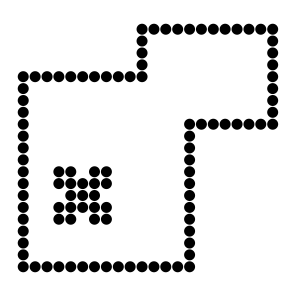
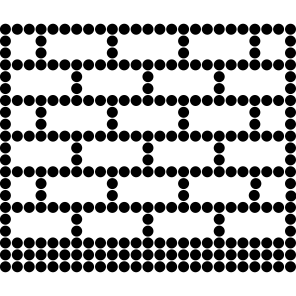
There’s an artist named Chris Jordan on the theme of trash and other questionable human practices using the once popular photomosaic techniques in the 90s. Jordan does a good job of contextualizing the trash and how it can communicate differently as a visual system of millions that appeals to many. The impact of the message of course being more significant than the actual work.

I guess the most green thing I could do today is simply turn off my computer. Hmmm. Okay. Will do.

There is no such thing as global warming
07_nosnow.jpg

As I went outside for an errand today, I couldn’t help but wonder if my home were teleported to California instead of cold, blustery New England. My snow shovel is outside, ready to go into action. Yet I’m going to the CVS in a T-shirt. Something is certainly wrong with the world. As I turned the ignition on my car, I felt a pang of guilt for not waiting an extra three months to receive delivery of a Prius. The situation with the environment, and how we live a modern lifestyle is not at all simple.

Simplicity Symposium: Part 3
walterbender.jpg

Walter Bender, One Laptop Per Child (OLPC) President of Content, discussed the design details of the so-called “hundred dollar laptop.” In his presentation, Walter described the three tenets of “being human” as: 1) We learn (and teach), 2) We express, and 3) We’re social. The design of the OLPC was created with his three human tenets in mind with its: 1) pedagogy, 2) digital expression capability, and 3) the mesh networking technology that makes it more of a “local” than a “global” machine.

Power consumption was a major design constraint for the OLPC given that it’s intended audience (the Third World) does not have the luxury of a constant and reliable power source. Thus the OLPC was designed to run at 2 Watts versus the 20 Watts of an average laptop through a variety of clever engineering feats. The third Key of power is relevant in this case, and it is clear that advances developed in the OLPC will point computer designs towards much more efficient power management schemes.

For as long as I’ve known Walter, he’s always claimed that the secret of the Web’s success was the way in which web browsers always had access to the source code of each web page through the “View Source” command. Because most of the Web was built in this open source manner, it became easy to replicate the knowledge of the Web with a simple cut and paste. He reasons that without this ease of playing with digital information in such an open manner, the Web would never have caught on. I think Walter’s right. At Ars Electronica, Walter showed off the new key on the keyboard of the OLPC “Src” which is the world’s first “View Source” key.

If Tim Berners-Lee is considered to be the “father” of the Web, I think it’s safe to think of Walter as the “uncle” of the Web for his early role in electronic media. The world is lucky to have Uncle Walter working on the OLPC project.

Cradle to Cradle

A disturbing but beautiful piece on why making things without a sense of our own global surrounds is … in short … simply evil (or at least ignorant).

Low Energy Living


Fresh bananas all-year-round.

I had the opportunity to visit the Rocky Mountain Institute headquarters building while in Aspen. This building is something of an eighth wonder of the world with its energy sipping approach to modern living. A variety of powering means that include solar and geothermal sources are able to make this eco-house a space that is livable even in the middle of a cold Colorado winter. Inside the house is a year-round garden complete with fruit-bearing banana tree. Warm-blooded pets are also a part of the heating system of the home. Feeling cold? Throw your dog a ball.

I was most impressed with the energy- and resource-efficient kitchen. The sink uses a standard aerated faucet fixture as a means to increase the usable surface area of the water. At MIT there is a little known science museum dedicated to Harold Edgerton with a machine whereby you can see the individual droplets of water within a flow of water by virtue of the flashing of the strobe. This was one of the first things I saw when I came to MIT in 1984 and has really stuck in my mind. When I was introduced to the aerated faucet at RMI, I felt I could see the droplets disperse into a dense cloud of washable material onto my hand. Whereas the standard faucet struck me as terribly wasteful as I could suddenly see all the big gloppy droplets that weren’t hitting my hand at all.

It is the combination of the image of Edgerton’s stopping time together with the aerated faucet’s ability to create more from less that rings in my mind as I scurry to make my new artworks for the Paris show.

Originally published here.